How can school visits by apprentices acting as role models change students’ gendered perceptions of STEM apprenticeships?
When apprentices talk about their apprenticeship and VET professions in classrooms at general education schools, they can change students’ perceptions and aspirations of these occupations. This is shown by the latest findings of a joint research project conducted by the Federal Institute for Vocational Education and Training (BIBB) and the Technical University of Darmstadt.
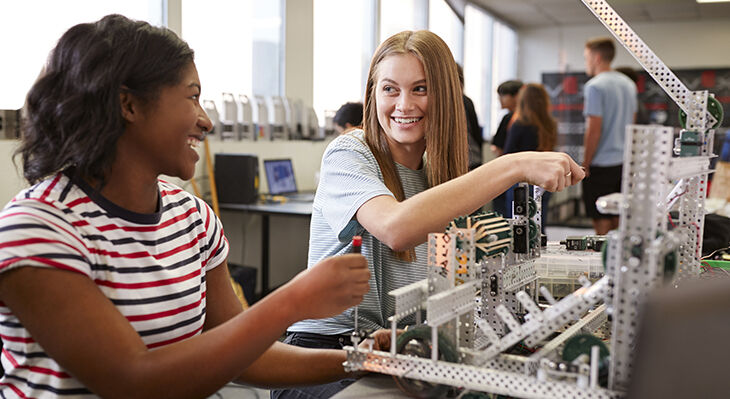
According to the study presentations and talks by VET ambassadors about their apprenticeship in a STEM (Science, Technology, Engineering, Mathematics) profession contribute, in particular, female students learn more about VET STEM occupations and make them more likely to consider these occupations as a career option. This is an important finding in view of the shortage of skilled workforce.
Study broadens the scope of existing research on STEM role models
In the German vocational education and training (VET) system, female apprentices are strongly underrepresented in STEM VET professions, particularly in technical and IT occupations. Based on a regional sample of male and female secondary school students in Germany surveyed in 2022 and 2023, our results indicate that students still hold gendered career aspirations, self-efficacy, and knowledge with respect to STEM VET occupations. Against this backdrop, the study looks at whether a vocational role model intervention of apprentices visiting schools could reduce gender differences in students’ aspirations toward VET STEM professions and change their gendered perception of these occupations in terms of their occupational knowledge, self-efficacy, and perception of tasks as interesting.
In doing so, the study broadens the scope of existing research on STEM role models, as it examines real-life encounters with apprentices in a classroom setting– that is, with young people who are close in age to the students and who share first-hand insights on eye-to-eye level their day-to-day working and learning experiences in their STEM apprenticeship.
Based on a non-equivalent control group design, the study shows that the role model intervention with mainly male role models can reduce these gendered perceptions to some extent, with female students developing greater occupational knowledge and higher career aspirations. No such changes were found among male students.
Male VET ambassadors can also encourage female students
Particularly noteworthy is the fact that the STEM VET occupations in the study were presented predominantly by male VET ambassadors, whereas previous studies have often focused exclusively on female role models. The findings therefore suggest that male VET ambassadors can also encourage female students to consider STEM occupations more strongly. In this respect, the study goes beyond previous assumptions that girls primarily need female role models in STEM occupations in order to feel addressed by these career options.
“The findings impressively indicate the importance of personal insights into the world of work for well-founded career orientation. VET ambassadors do more than simply provide information about occupations. They make vocational training tangible and provide young people with practical insights into the world of work, potentially opening up new career opportunities for them.
This is particularly relevant in areas where stereotypical perceptions continue to constrain young people’s career choices.”
Prof. Dr. Hubert Ertl, Vice President and Director of Research of the Federal Institute for Vocational Education and Training (BIBB)
At the same time, the study also highlights some limitations. Whilst the school visits increased students’ occupational knowledge of STEM VET occupations and strengthened female students’ aspirations to consider these occupations, occupational self-efficacy – that is, students’ assessment of whether they would be able to successfully complete vocational training in such an occupation – did not increase. Further action is therefore needed in this area.
Five characteristics make the study particularly valuable for evidence-based career guidance: it focuses on STEM professions in vocational training rather than primarily on academic courses. It examines real-life interactions in the classroom rather than examples presented through the media. It centres on apprentices who are of a similar age and report on their practical experiences as peers. It also focuses mainly on male STEM VET ambassadors, whereas earlier studies often examined female role models, and, lastly, it analyses the impact on both female and male students
The study surveyed 1,041 students at general education schools from grade 9 onwards. It examined whether personal accounts from apprentices could help female and male students become more familiar with STEM occupations and make them more likely to consider these occupations as a career option. Students were surveyed before and about 8 weeks after the VET ambassadors’ visits; a control group was surveyed as well.
Background
The study “Can vocational role models change the gendered perception of STEM VET occupations? Results from an intervention study in Germany” was published by Janina Beckmann, Ermioni Athanasiadi and Mona Granato. It is based on the BIBB-TUDa Career Orientation Study.