Competences for the digital workplace (KoDiA) – Capacity building for digitalization
The research project “Competences for the digital workplace (KoDiA) – Capacity building for digitalization”, has been carried out in cooperation with the Helmut Schmidt University Hamburg (HSU) since 2021. KoDiA is a joint project of the Center for Technology Based Education and Training (ZtB) of the HSU and the Federal Institute for Vocational Education and Training (BIBB). The project explores the influence of digitalization on vocational education and training.
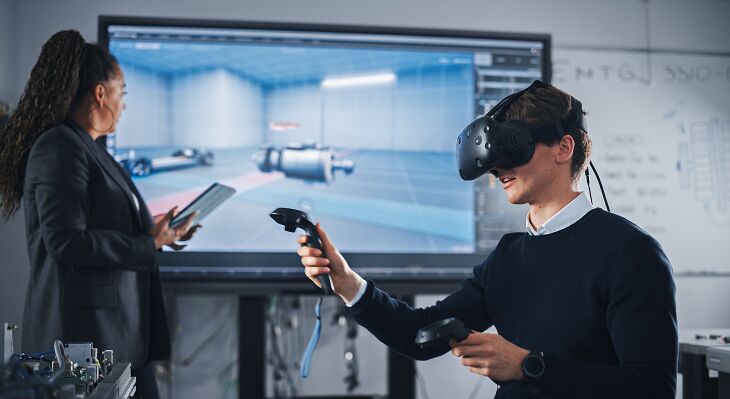
Trainees are the skilled workers and managers of tomorrow. They need to meet the demands of digital workplaces and of a digitized everyday life. The digital transformation also provides opportunities for change in education. Digital learning media and tools for collaboration, learning with augmented reality (AR) as well as virtual reality (VR), and rapidly developing technologies in artificial intelligence (AI) provide possibilities for a transformation of vocational education and training, and carry the potential to meet learners’ individual needs. But what does this translate into when it comes to vocational education and training? How has the training system responded to this change? Are digital tools used in vocational education and training or do companies and vocational schools need additional support?
Trainees and employees need specific competences when working with digital technologies. Accordingly, well-developed digital competences help individuals keep up with digitalization, pursue further training or career advancement, and meet the constantly changing demands of workplaces. However, digital competences are not only key to a successful professional future, but also crucial for participating in social and political life. Promoting such competences as part of vocational training therefore impacts areas far beyond the workplace, as they empower individuals to participate in public life and society. An approach to vocational education and training with digital competences in mind therefore ensures the viability of society, now and in the future.
Within the wider joint project of KoDiA the research team at BIBB works to enhance digital competences among trainees who use digital learning media as part of their apprenticeships. Additional project partners to support this endeavour are the Hamburg Institute for Vocational Education and Training (HIBB) and vocational schools across Hamburg. The BIBB research team used qualitative group discussions (focus groups) to explore how teachers at vocational schools in Hamburg view students' digital competences and how teachers support students to develop these competences in classrooms. In addition, the research team conducted a quantitative online survey to examine the interests and needs of students at Hamburg vocational schools regarding their use of digital learning media and their participation in digital life.
Key reference points in KoDiA are definitions of digital competences from the strategy for education in a digital world of the Standing Conference of the Ministers of Education and Cultural Affairs (KMK), on the DigComp Framework of the EU, and on the newly established standard occupational profile for a digital working world introduced in 2021, taught across all vocational training programmes.
The project “Competences for the digital workplace (KoDiA) – Capacity building for digitalization” is part of the research focus “Competences for the digital workplace (KoDiA) – Capacity building for digitalization” of dtec.bw – Center for Digitalization and Technology Research of the German Armed Forces.
For more information see recent project publications and dissemination activities (in German)