Should I stay or should I go? TVET conference in Uzbekistan
31.10.2025
The further development of vocational education and training (VET) in Uzbekistan and options for skilled labour migration to Germany, against the backdrop of the Skilled Immigration Act, were key topics discussed during this closing project conference. Birgit Thomann of the Federal Institute for Vocational Education and Training (BIBB) was invited to give the keynote speech of this conference, which was organized by the Deutsche Gesellschaft für Internationale Zusammenarbeit (GIZ).

Strategically located between the East and the West on the Silk Road, Uzbekistan has a hub for ideas and innovation for thousands of years. Uzbeki interest in Germany has been growing for years. More and more young people are choosing to learn German and are showing interest in training or working within the country.
With the German-Uzbek agreement on a comprehensive migration and mobility partnership, signed in October 2024, Germany and Uzbekistan have agreed to improve cooperation in the area of regular migration, with a particular focus on vocational training.
Against this backdrop, the Deutsche Gesellschaft für Internationale Zusammenarbeit (GIZ) in Uzbekistan invited participants to Samarkand on the 9th and 10th of October 2025 for the final conference of the project Supporting the reform and modernisation process in Uzbekistan's VET system (TexVET).
The aim of the conference was to present the project implementation experiences of GIZ and its project partners. The main focus was on exchanging the most important results and insights gained, as well as discussing future steps for reforming VET in Uzbekistan.
In her keynote speech, Birgit Thomann (Head of the International Department, BIBB) spoke about the structural features of the dual VET system in Germany, emphasising the current challenges.
For companies and vocational schools, this includes the increasing diversity of learners and improving the match between young people who want to start training and training companies. Moreover, the major transformation issues such as digitalisation, academisation and demographic trends.
730x399px_rdax_80p.jpg)
With the Skilled Immigration Act (2023/24), Germany aims to make it easier for skilled workers with professional qualifications and people with practical work experience to access the German labour market, thereby addressing the shortage of skilled workers in Germany.
In his reply, the Director of the Institute of Development of Professional Education (MHESI) Uzbekistan, Zayniddin Khudoyberdiev, expressed great interest in strengthening cooperation with Germany, and in particular with BIBB, in order to further develop the Uzbek VET system.
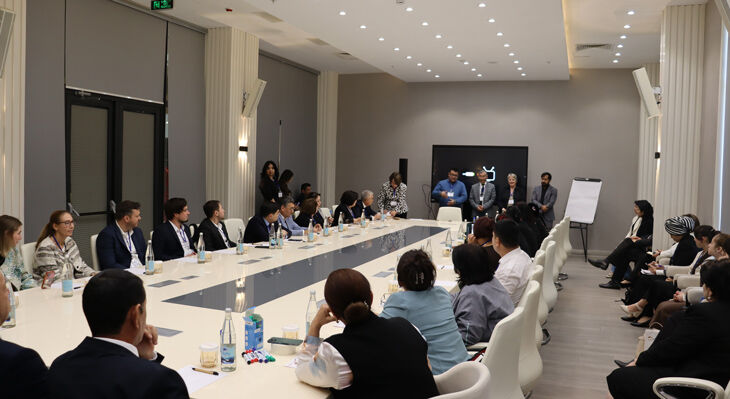
In the afternoon, the participants discussed fundamental issues relating to VET and migration at “themed stations” in a World Café format. The first station focused on how to close the gap between theory and practice in skilled labour migration. The second station addressed the conditions under which a country can afford to offer dual training. Participants at the third station discussed which stakeholders could serve as ambassadors for dual VET. Finally, station four dealt with the structures required for successful immigration to Germany of interested Uzbek skilled workers. This station was organized by BIBB.
“Should I stay or should I go”
Under the headline ‘Should I stay or should I go,’ a wide range of aspects relating to migration were discussed. BIBB staff, Birgit Thomann and Alexander Studthoff moderated the discussion, which dealt with the questions of ‘how’ and ‘to whom’ should knowledge of the legal framework for skilled labour immigration be communicated. Moreover, what information to convey regarding recognition processes when moving between Uzbek and German VET systems.
It became clear that Uzbekistan – as a classic country of emigration – has its own migration agency with offices throughout the country, which are ideally placed to advise Uzbeks who are interested in migrating to Germany.
Shonosir Shakhrahmedov (Simson Private Akademie, Thuringia) illustrated the potential of the German education sector in terms of fair skilled labour migration. This was a best practice in the field of skilled labour recruitment within the iMOVE network at the BIBB.
Afrosiyob jeans factory and Samarkand carpet workshop
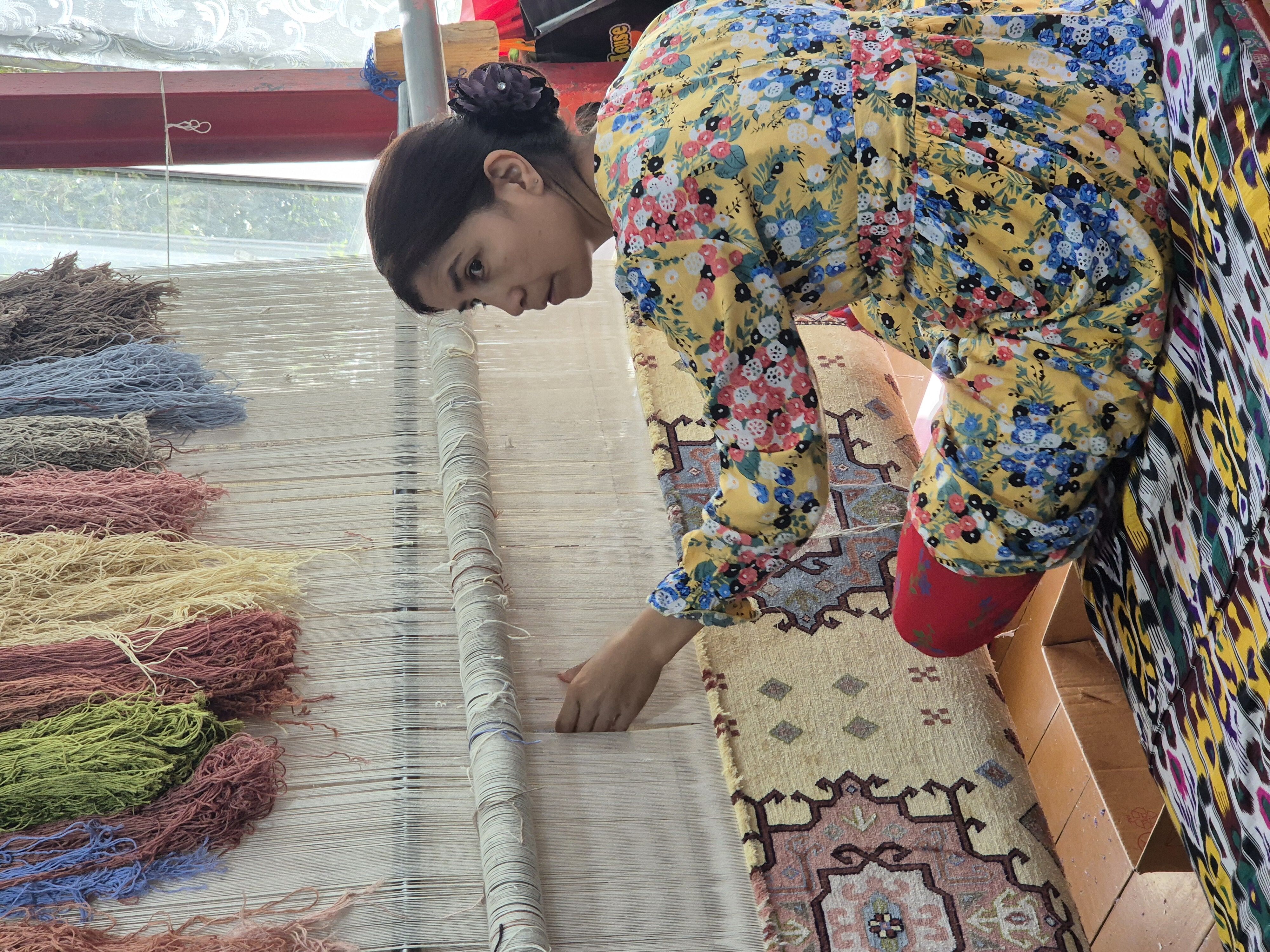
A visit to the Afrosiyob jeans factory and the Samarkand carpet workshop the following day highlighted the historical significance of the textile sector in Uzbekistan.
In particular, insights into the work of carpet weavers who have migrated from Afghanistan to Uzbekistan also provided food for thought in relation to skilled migration. Work like this preserves a millennia-old craft that is held in high esteem. However, recognition of these qualifications in Germany would currently be virtually impossible, as there is no corresponding reference occupation.
_730x399px_rdax_80p.jpg)
The work of the VET project from GIZ will be continued in a follow-up phase, in which close cooperation with BIBB is desired. This was confirmed during the conclusion by Dr. Carolina Probst, a representative of the Federal Ministry for Economic Cooperation and Development (BMZ), who was also present.