Digital VET Tools from Germany and Brazil
How can artificial intelligence (AI) improve the quality of vocational education and training? What digital tools are already available to teachers and trainees today? These and other key questions were at the heart of an international expert dialogue that brought together professionals from Latin America, the Caribbean, and Germany.
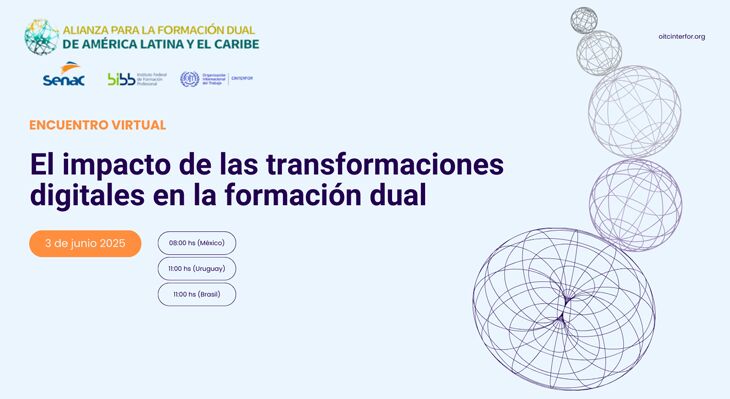
On June 3, 2025, the virtual expert forum “The Impact of Digital Transformation on Dual Vocational Education and Training” took place – organized by the Alliance for Dual Vocational Education and Training in Latin America and the Caribbean. More than 200 participants attended the event, which provided practical insights and created space for in-depth exchange.
The webinar was opened by Kelly Teixeira from the National Department of SENAC, Brazil’s vocational education and training institute in the area of commerce. In her welcome address, she emphasized the importance of digital transformation for vocational education and reaffirmed SENAC’s strong commitment to future-oriented development in this area.
On behalf of ILO/Cinterfor, Gonzalo Graña welcomed the participants, representing Director Elena Montobbio. He underlined the value of such dialogue formats for strengthening the connection between vocational education and the world of work - especially in times of rapid digital change.
Innovation in Practice: AI Projects from Germany and Brazil
Following the opening, Ilona Medrikat from the Federal Institute for Vocational Education and Training (BIBB) introduced the first speaker: Dr. Inken Rabbel, an expert in digital teaching and learning formats and project manager at the German Association for Water, Wastewater and Waste (DWA). Dr. Rabbel presented the AZUKIT pilot project, which is developing an innovative digital learning environment and an AI-supported learning tutor for trainees. The tutor identifies individual knowledge gaps and delivers personalized learning content—specifically designed for the training of environmental technologists in wastewater management.
The aim of the project, which is funded by the responsible German Federal Ministry under the InnoVET PLUS excellence initiative and supported by BIBB, with four consortium partners involved, is to enhance the attractiveness of vocational training and to sustainably improve trainees’ exam success through the use of this digital learning approach.
The project was widely recognized by participants as forward-looking, particularly in terms of its potential to be transferred to other vocational fields.
The second expert, Arthur William Santos, Head of Educational Technologies at SENAC Brazil, presented the institution’s current progress in integrating AI into vocational education. He showcased conversation simulators that enable learners to practice communication skills in realistic scenarios, as well as digital assistant systems that support teachers in planning lessons. Santos emphasized that these technologies are embedded within SENAC’s pedagogical model and guided by ethical principles for the responsible use of AI.
Shaping Digitalization Together
The subsequent discussion focused on key issues such as data protection, the didactic integration of digital tools, and the need to adapt curricula in light of rapid technological change. Participants agreed that technological innovation requires clear regulatory frameworks, pedagogical support, and continuous professional development for teaching staff.
The event also provided insights into international cooperation with other networks, such as the participation of Kelly Teixeira from SENAC—representing the presidency of the Alliance—at the UNESCO-UNEVOC BILT Forum in Kuala Lumpur, where the contribution of Latin America and the Caribbean to the digital transformation of vocational education and training was particularly highlighted.
Continuing the Dialogue
The event series will continue on June 26, 2025, with another virtual expert session on AI and Digital Transformation. Three additional webinars focused on standard development are scheduled for July 24, August 21, and September 23, 2025.
With this series, the Alliance for Dual VET in Latin America and the Caribbean provides a vital platform for international knowledge exchange and joint efforts to shape the future of vocational education. The events are coordinated by the Alliance’s Steering Group, composed of this year’s presidency SENAC Brazil, BIBB, and ILO/Cinterfor.