International expert discussion on micro credentials in vocational education and training highlights regional innovations and implementation challenges
As part of the European Micro Credential Days (3–5 November 2025) at the Federal Institute for Vocational Education and Training (BIBB), a hybrid expert discussion was held on 4 November 2025 to discuss the transformative potential of micro credentials in vocational education and training. Under the title "What's Next with BEM micro credentials?", participants from Armenia, Ukraine, the Western Balkans, Sweden, Croatia and Germany discussed the expected benefits, implementation challenges and strategic approaches to the development of micro credentials.
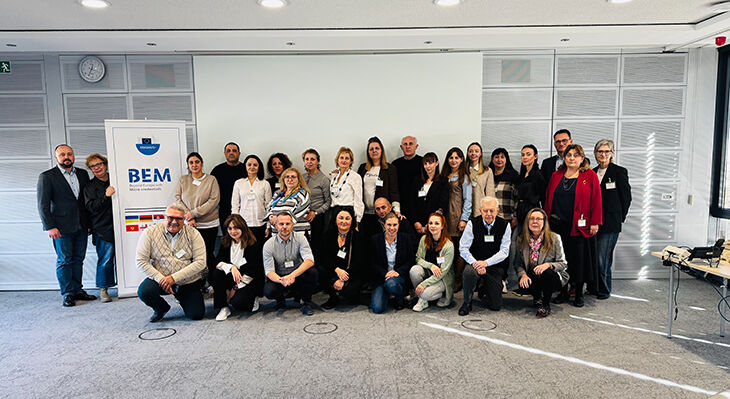
Regional perspectives on the implementation of micro credentials in VET
The event included presentations from three key regions of the BEM project, each offering insights into national contexts and strategic priorities. Tatevik Gasparyan, Director of the National Centre for the Development of Vocational Education and Training in Armenia, emphasised the particular importance of validating prior learning and creating accessible educational pathways for learners in rural communities, where traditional vocational training infrastructure remains limited.
Slavica Dimovska shared perspectives from the Western Balkans, highlighting how cross-border regional cooperation can accelerate both the recognition of micro credentials and the involvement of local and regional businesses. Her presentation showed that legislative and regulatory challenges, although significant, can be addressed more effectively through coordinated regional strategies than through isolated national efforts.
The Ukrainian perspective, presented by Yurij Balaniuk, Director of the National Qualifications Authority (NQA) of Ukraine, and Snizhana Leu-Severynenko, revealed how micro credentials are being promoted as tools for labour market resilience and the integration of internally displaced persons – even amid extraordinary national challenges. This commitment to social inclusion goals, even in crisis contexts, underscored the flexibility and relevance of the micro credential approach in Ukraine.
Critical success factors and implementation challenges
The expert panel consisted of Karin Luomi-Messerer (3s Vienna), Marine Jamkochian (President of the Business and Education Partnership Foundation in Armenia), Iryna Shumik (Ministry of Education and Science of Ukraine) and Veronika Ivanova (Erasmus+ Office, Ukraine). A recurring theme in the discussion was methodological flexibility combined with quality assurance. It was emphasised that there is no one-size-fits-all solution when it comes to adapting European vocational training formats to diverse national contexts.
Social inclusion as a central goal
A particularly noteworthy outcome of the discussions was the unanimous commitment of all partner countries to use micro credentials as instruments for social inclusion and not just for system efficiency. All speakers emphasised that micro credentials must serve marginalised population groups, including geographically disadvantaged learners, socially vulnerable groups, internally displaced persons and workers in career transition. The expert discussion at the BIBB made it clear that the development of micro credentials in diverse national contexts requires more than methodological frameworks and digital infrastructure. It requires honest recognition of challenges, creative adaptation to local circumstances, sustained commitment to social inclusion goals and genuine partnership across borders and institutional contexts.
About the BEM project
Beyond Europe with Micro Credentials (BEM) is an Erasmus+ Capacity Building project in vocational education and training, running from January 2023 to December 2025. Coordinated by SBG Dresden in partnership with BIBB, the project brings together 17 organisations from Germany, Norway, Armenia, Georgia, Ukraine, Serbia, North Macedonia and Montenegro to develop sector-specific micro credentials that pursue two goals: labour market relevance and social inclusion.