Foresight studies for the Brazilian labour market
15.04.2026
BIBB cooperation partner SENAI, a Brazilian education provider, uses foresight studies to ensure that its training programmes and courses meet the future needs of industry. In this BIBB interview, Foresight Practitioner Marcello Pio explains, which factors are taken into account in this procedure.
Our world is constantly changing. Technical progress as well as social and ecological changes have a particular impact on TVET. Training regulations in Germany are often worded in a ‘technology-neutral’ manner so that they remain in force in the long term and do not need to be revised immediately every time a new development arises. And yet, regular updating processes are also necessary here.
And what is the situation like in Brazil? Marcello Pio works as Foresight Practitioner at the Brazilian Industry Confederation CNI. He develops foresight studies for the TVET provider and BIBB cooperation partner SENAI, the National Service for Industrial Training, that form the basis for new or updated training programmes or courses. The Federal Institute for Vocational Education and Training (BIBB) is recognized as a center of excellence for vocational research and for the progressive development of vocational education and training (VET) in Germany.
Interview
Marcello, you are an expert in forecasting models for the industrial sectors in Brazil. When did you start this work?
In 2004, a new unit for foresight studies was established at SENAI. It was a very small unit, there were only three of us. We had set our minds on developing a model that could be used to identify changing requirements for occupational profiles. This would enable the education provider SENAI to adapt its offerings flexibly. Currently, this unit called “Industry Observatory” is part of CNI.
At that time, you developed a model that you basically still use today.
Exactly, with changes over the course of these 20 years, of course. It must be said that this work is still relatively unique in Brazil today. SENAI was a pioneer at the time and has always had a keen interest in providing practice-oriented, future-proof training programmes matching the demands of the labour market. It must be said that universities are often quite far removed from the actual needs of the labour market.
And how was your project received by the industry at the time?
In fact, we had to convince a lot of people at the beginning, including the head of TVET at SENAI. At the time, it was something completely new, because almost no one in Brazil was talking about it, nor did anyone have a clear idea of what foresight studies were. Unlike other countries, such as the USA or France, which started after the Second World War, Brazil only began using foresight models in the late 1990s and early 2000s. Over time, many decision-makers in Brazil came to recognize the importance of developing long-term occupational profiles that would not become obsolete within the next five to ten years. This need was expressed above all by companies.
Operational roles shrink while occupations with technological, analytical, and systemic skills grow.
Let's now take a look at your specific work. What, for example, are your foresight insights for the renewable energy sector?
Our studies show that the energy transition and digitalization are reshaping professional profiles in the renewable energy sector. Operational roles shrink while occupations with technological, analytical, and systemic skills grow. Traditional jobs now demand digital competencies (sensing, monitoring, data analysis), integration of engineering, IT, and management, sustainability and regulatory knowledge, and the ability to work in hybrid field–digital environments. Many roles evolve from “executive technician” to technician‑analyst or energy‑systems specialist. New professionals emerge in hybrid system operation, smart‑grid integration, or green hydrogen. As a matter of fact, we will need continuing TVET programmes in renewable energies with a strong digital component. Training must expand in automation, IoT, data analysis, and regulation.
And how exactly do you arrive at your predictions for such future developments?
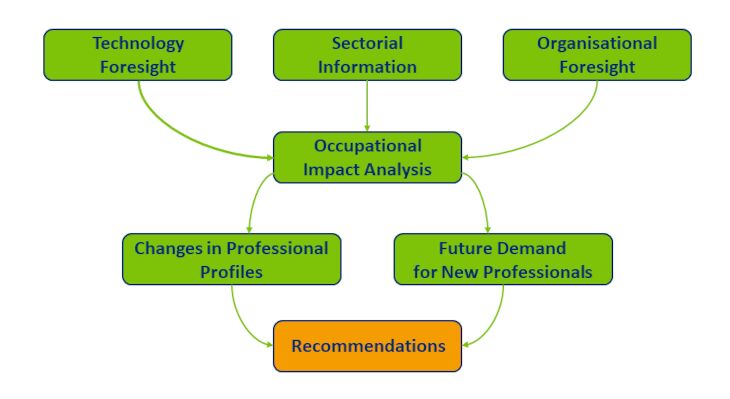
The principle of our studies is as follows: companies are confronted with new technologies, new management tools and new business models and see a need for new or updated occupational profiles. We then apply our foresight model. It is divided into three phases. In the first phase, we analyse and describe new technologies, management tools and business that could be relevant to the sector in question. Our model considers emerging technologies, that is, those that are already known to the market, but which are still in a very early stage of diffusion or are in a pre-commercial stage, and are sometimes being showcased at trade fairs.
For foresight studies on vocational education, it is important to consider technological evolution and organizational changes. To highlight this importance, I would like to cite an example from when I first applied the model to the Brazilian civil construction sector in 2005. At that time, BIM, or Building Information Modelling, was brand new. It allows buildings to be planned, constructed and operated digitally. But when we discussed the degree of diffusion of BIM with experts, almost all of them agreed that it would not become widespread within the next five to ten years. As it was a very new technology, companies still had difficulty recognising its importance. In addition, the initial investment was very high. Without these assessments, SENAI might have offered BIM courses at a time when skilled workers would not yet be able to use it in their jobs. So, you see, SENAI cannot be too progressive in its training but should always be guided by the needs of the companies.
SENAI should always be guided by the needs of the companies.
In the second phase, we analyse the impact of technological or socio-economic changes on the labour market. At this phase, the impacts on occupations already operating in the market are detailed in the form of new activities, skills, abilities, and knowledge. Furthermore, we have identified new professionals and courses that may be in demand by companies in the sector being analysed.
Here, too, diversity must of course be taken into account: the diffusion depends, for example, on the size of the company, but also on the region. Often, a development spreads with different intensity and speed in São Paulo than in Rio Grande do Norte, Paraná or other regions, for example.
In the third phase, we recommend some actions so that SENAI and TVET institutions in general can prepare to implement the changes in profiles and offer new courses and train new professionals.
How detailed can you make your findings when broken down to the level of specific occupations?
Due to resource constraints, it is practically impossible for us to determine the impact on all occupations in the respective sector. We therefore determine the occupations that will be most affected by the technologies and organisational changes. We then examine these in more detail. To identify changes in current professional profiles and to identify new professionals and new courses, we conduct consultations with experts in the form of individual interviews or by organizing Expert Panels, in which between 15 and 20 invited experts discuss and seek to reach a consensus on these topics.
For each occupation, we identify which activities will be performed in this occupation in the next five to ten years and which will not. What new knowledge will the future skilled workers need? What new skills? At the same time, we also make a quantitative estimate of the demand for new skilled workers.
After the study is completed, it is sent to a group of sector experts from SENAI and companies to be used in updating the professional profiles currently formed, as well as new profiles that may be designed.
How do you select these companies?
We always involve an industry association. We want to reflect the needs of the different companies in a sector, including differences in company size and region.
Are employees or trade unions also involved, as is the case here in Germany?
Employees and unions participate in the discussion process regarding the updating of profiles and the creation of new ones in the Sectoral Technical Committees, organized by SENAI. The members of the committees use the prospective studies for discussion. They do not participate directly in the construction of the prospective study.
Nevertheless, such modernisation processes are certainly quite time-consuming. How often do you carry them out?
Each of the 28 sectors in which SENAI operates is reviewed every three years. That means I carry out ten such processes every year.
The overarching goal of our foresight work is to reduce uncertainty among decision-makers. How intensively should I offer a course for a new field of study? Do I actually have to offer a new training programme? Or is it sufficient to specialise in an existing occupation? So, we generate information to ensure that SENAI faces as little uncertainty as possible about the future during its strategic planning process. However, some uncertainty will always remain, because the future, by its very nature, does not yet exist.
Last question: If you look at the German system, where do you see further differences in the modernisation of training? Where could Germany learn from Brazil and vice versa?
I have little knowledge about the German TVET system, but generally speaking, the Brazilian TVET system can, of course, learn a great deal from the dual system. And also, how to use the information generated in foresight studies in this process with companies. Foresight studies indicate future trajectories, but it is not always known where and how to learn on the factory floor.
Thank you very much for talking to us!
The content of the training is defined in such a way that it is as up-to-date and technology-neutral as possible, so that it remains valid in the long term and does not have to be revised immediately with every innovation. At the same time, this openness enables companies to flexibly integrate modern processes and current technologies into their training programmes. The modernisation cycles of the training regulations are usually between five and ten years. Cooperation between the state, industry (employers) and employee representatives (trade unions) is of great importance in the German system.
More information on the creation and updating of training regulations
The projections on occupations and qualifications (QuBe) carried out by BIBB are based on several interlinked models. First, population trends are projected. From these trends, the labour supply (the working-age population) is then determined by qualification and occupation. Secondly, household and government consumption patterns, global trade and the interdependencies of intermediate inputs across sectors are analysed. These factors determine how many people the economy will require in employment in the future. They also show in which sectors and occupations these people will be needed. The labour force and those in employment can be compared at occupational level. If they develop differently, this indicates a tighter or a looser occupational labour market.