Global Skills Forum in Malaysia
21.11.2025
The Federal Institute for Vocational Education and Training (BIBB) presented findings from German TVET practice and BIBB research during a high-level conference hosted by Malaysia in the context of the ASEAN Year of Skills 2025.

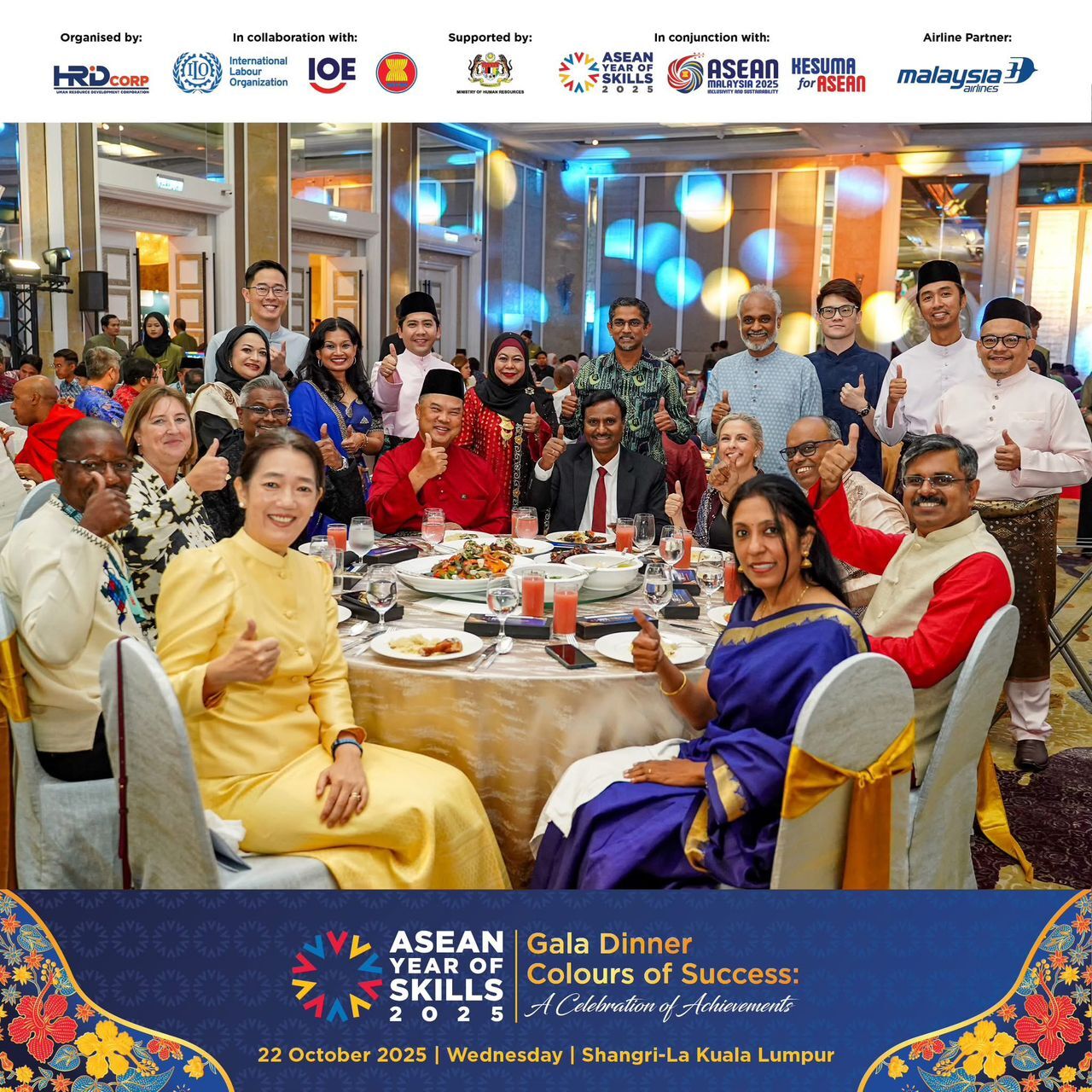
Over 500 participants from more than 50 countries, including high-ranking policy-makers and experts, exchanged views on 22 and 23 October at the Global Skills Forum 2025 in Kuala Lumpur, Malaysia, under the title ‘The Role of the Private Sector in Skills Development: Driving Innovation and Impact’.
Participants discussed strategies and success stories for greater involvement of the business community in vocational education and training, as well as qualification systems worldwide.
The conference, organised by the Human Resource Development Corporation (HRD Corp) under the Ministry of Human Resources Malaysia, in collaboration with the International Labour Organization (ILO) and the International Organisation of Employers (IOE), focused on public-private partnerships (PPPs), sector skills bodies (SSBs), innovative training approaches and the use of digital technologies to strengthen future-oriented vocational training.
The forum was officially opened by Malaysia's Deputy Prime Minister Ahmad Zahid Hamidi, ILO Director-General Gilbert F. Houngbo and the Malaysian Minister of Labour, Steven Sim.
Contributions from the Federal Institute for Vocational Education and Training (BIBB): Success factors and challenges in the German vocational education and training system
On the first day of the conference, Birgit Thomann, Head of the International Department at BIBB, explained the role of companies in the German dual vocational training system. This took place during the high-level panel discussion on ‘Strategies and Good Practices for Effective Engagement of the Private Sector in Skills Development’. She emphasised that close cooperation between the state, industry and social partners makes the system an internationally recognised model of success. However, current challenges facing vocational education and training in Germany, also provided food for thought. Among which are trends towards academisation, mismatches between young people interested in training and training companies, as well as demographic change, which is exacerbating skilled labour shortages.
Felipe Morgado, Superintendent for Vocational and Higher Education at the Brazilian BIBB partner institute Serviço Nacional de Aprendizagem Industrial (SENAI), presented examples of industry-led training models that are driving the transformation of the world of work.
Datuk Captain Izham bin Ismail, Executive Director of Malaysia Airlines Berhad, showed how targeted continuing education and training tailored to operational requirements can contribute to increasing the performance and resilience of companies.

In the session "Transforming Training Provision – The Role of the Private Sector: Quality Apprenticeships and Work-based Learning", Birgit Thomann presented key elements of dual training in Germany and linked them to ILO Recommendation 208, which sets standards for high-quality training. She focused in particular on the role of social partners, the development of common training standards, the qualification of training personnel and the importance of research-based policy advice. The panel also included Ousman Sillah, Secretary General of SASASNET, an African network for the promotion of vocational education and training initiatives, Prof. Eliamani Mathew Sedoyeka, Rector of the Institute of Accountancy Arusha (IAA) in Tanzania, and Dato' J. Palaniappan, representative of the ASEAN Future Workforce Council from Malaysia.
Birgit Thomann summed up the exchange during the Global Skills Forum: "In an international context, the BIBB contributes to fruitful discussions with practical experience and research findings on the principles of the German dual system, such as consensus building in social partnership and the perspective of German companies on the costs and benefits of in-company training. At the same time, the Global Skills Forum provided impetus for the German context with innovations.”
‘Towards a Global TVET Agenda’ – Expanding the partnership with the ILO
With its contributions to the Global Skills Forum, the BIBB strengthened its networking with well-known and new international partners and actively brought the German perspective of joint (including financial) responsibility of the state and industry for vocational education and training into the global dialogue on future-oriented, practice-oriented vocational education and training systems.
Furthermore, the BIBB's participation reaffirms its close cooperation with the ILO, which has currently taken on particular significance with the BMBFSFJ initiative ‘Towards a Global TVET Agenda’: The BIBB coordinates the Initiative, which was officially launched on 28 October 2025, and works together with four multilateral partners. In addition to the ILO, these are the UNESCO International Centre for Vocational Education and Training (UNESCO-UNEVOC), the Organisation for Economic Co-operation and Development (OECD) and the European Training Foundation (ETF). The aim is to develop common priorities for a global TVET agenda.