Towards a Global TVET Agenda
Targeted strategic cooperation with multilateral organizations and regional partners worldwide will strengthen Technical and Vocational Education and Training (TVET). What exactly is behind the "Towards a Global TVET Agenda" Initiative?

Global challenges in technical vocational education and training require strengthening international cooperation. The heart of this Initiative relies on the exchange of experiences related to reform processes, standards, and innovative approaches, as well as professional cooperation and mutual learning.
From a German perspective, one thing is clear: the future of TVET is at stake! International cooperation is key to embracing innovation and designing modern, attractive TVET. How can we support the supply of skilled workers and social participation in the German system – and how can we do so worldwide, with a particular focus on work-based learning (WBL) and dual training approaches?
Multilateral organizations play a central role: they promote global dialogue, set international standards, and drive innovation.
Multilateral organizations as key partners
The backbone of the "Towards a Global TVET Agenda" Initiative are multilateral organizations.
On behalf of the Federal Ministry for Education, Family Affairs, Senior Citizens, Women and Youth (BMBFSFJ), BIBB is working with four multilateral partners:
- The UNESCO-UNEVOC International Centre for Technical and Vocational Education and Training (UNESCO-UNEVOC),
- International Labor Organization (ILO)
- Organisation for Economic Co-operation and Development (OECD)
- European Training Foundation (ETF)
From the beginning of 2025 until the end of 2027, the partners are implementing concrete measures in four focus areas:
- Knowledge sharing and global fora
- Global and regional TVET innovations – capacity building for social partner involvement
- Prototyping TVET data reporting
- Partnership for Excellence
The development of a joint global agenda begins with strengthened global partnership and coordinated action.
Open policy partnership
Regional policy partners and networks, such as the European Commission, the African Union, the ASEAN TVET Council, and the Alliance for Dual Education in Latin America and the Caribbean, play a key role as catalysts and links to regional strategy processes. In addition, WorldSkills International and WorldSkills Germany support the agenda process. In the future, the open cooperation model – or open policy partnership – is expected to expand to include additional partners, with the aim of jointly strengthening TVET systems worldwide.
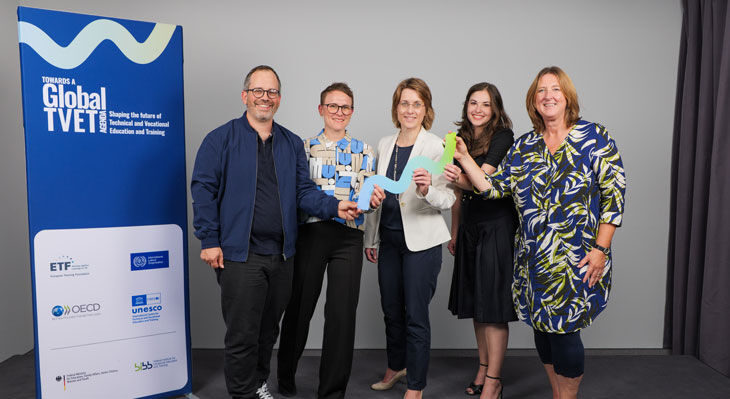
Development of the Global TVET Agenda
For the joint process "Towards a Global TVET Agenda," BMBFSFJ and BIBB have identified the following priorities:
We are actively involved in shaping European and international TVET strategies. Together with our multilateral partners UNESCO-UNEVOC, ILO, OECD, and ETF, we are providing impetus for high-quality, sustainable, and inclusive TVET based on the principles of dual VET and work-based learning.
We connect policy makers. This fosters a global policy partnership to strengthen TVET. At the same time, we promote the exchange of information on successful regional reform processes, guidelines, and standards in TVET. The discourse on excellence in TVET is of particular importance in this context.
Research findings form the basis for further developing TVET. At the same time, there are gaps in knowledge and data. We promote cooperation between leading international organizations to close these gaps and advance global and international comparative data reporting.
Strategic cooperation with centers of excellence and competence is essential for innovation transfer and international competitiveness. This offers opportunities for partner regions and leads to positive results for the further development of TVET in Germany.
We stand by the use of dual VET and work-based learning as models and advocate strongly for their integration into TVET. The Initiative strengthens international exchange on dual VET as it relates to key topics such as, involvement of social partners, trainees’ rights, and in-company training staff qualifications.