Everything AI – setting up AI for sustainability
12.11.2026
From social cohesion to the latest HR tools, from the Buddhist perspective on the value of time to mass layoffs in global labour markets: the Global HR Forum in Seoul examined the major developments of our time and, under the theme ‘Everything AI – The Path to Sustainability’, brought together around 5,000 experts from various fields to engage in dialogue.
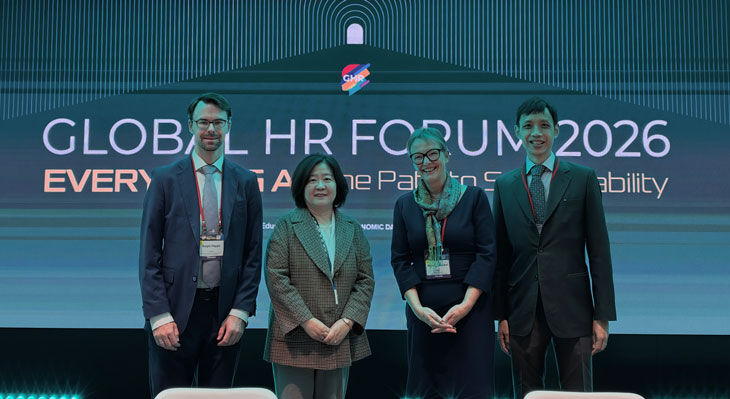
‘Everything AI – the path to sustainability’: With this year’s theme, the organisers of the Global HR Forum leave no doubt as to the societal significance they attribute to artificial intelligence for the future. This year, therefore, the focus is not on how AI affects one or another area of life to a greater or lesser extent. ‘Everything AI’ means that AI, as a technology, literally permeates every area of life and fundamentally transforms it.
The potential for change attributed to the further development of Artificial Intelligence is immense and difficult to grasp in its entirety. True to the motto ‘one step at a time’, the Global HR Forum has therefore set itself the aim of casting light on various sectors of society. To this end, international experts from a wide range of disciplines were invited. Start-up founders discussed the big question alongside CEOs of large companies, researchers in political science and philosophy, various authors and even a Buddhist monk: ‘In a world where AI can do almost anything, what does it mean to be human?’
The discussion centred not only on how AI affects education and labour markets, but also on how our social and tax systems are evolving, how AI exacerbates social inequalities, and how AI impacts people’s self-image when they no longer have to labour to acquire certain skills. What happens when the satisfaction of having achieved something independently and through one’s own efforts is lost? How do we fill the time that becomes available when AI applications take work off our hands?
The latter point in particular was the subject of heated debate: many experts emphasised the need for human control over AI systems and agents. They argued that this makes the participatory development of AI, careful risk assessment and the preservation of expertise in various fields indispensable. What is needed is not a reduction in education, but a transformation of educational provision and teaching methods.
All these developments were simultaneously scrutinized from an angle that marks the tension between prosperity and sustainability. The goal was also to address the question of how artificial intelligence can be integrated into future ways of life in a socially, economically and environmentally sustainable manner.
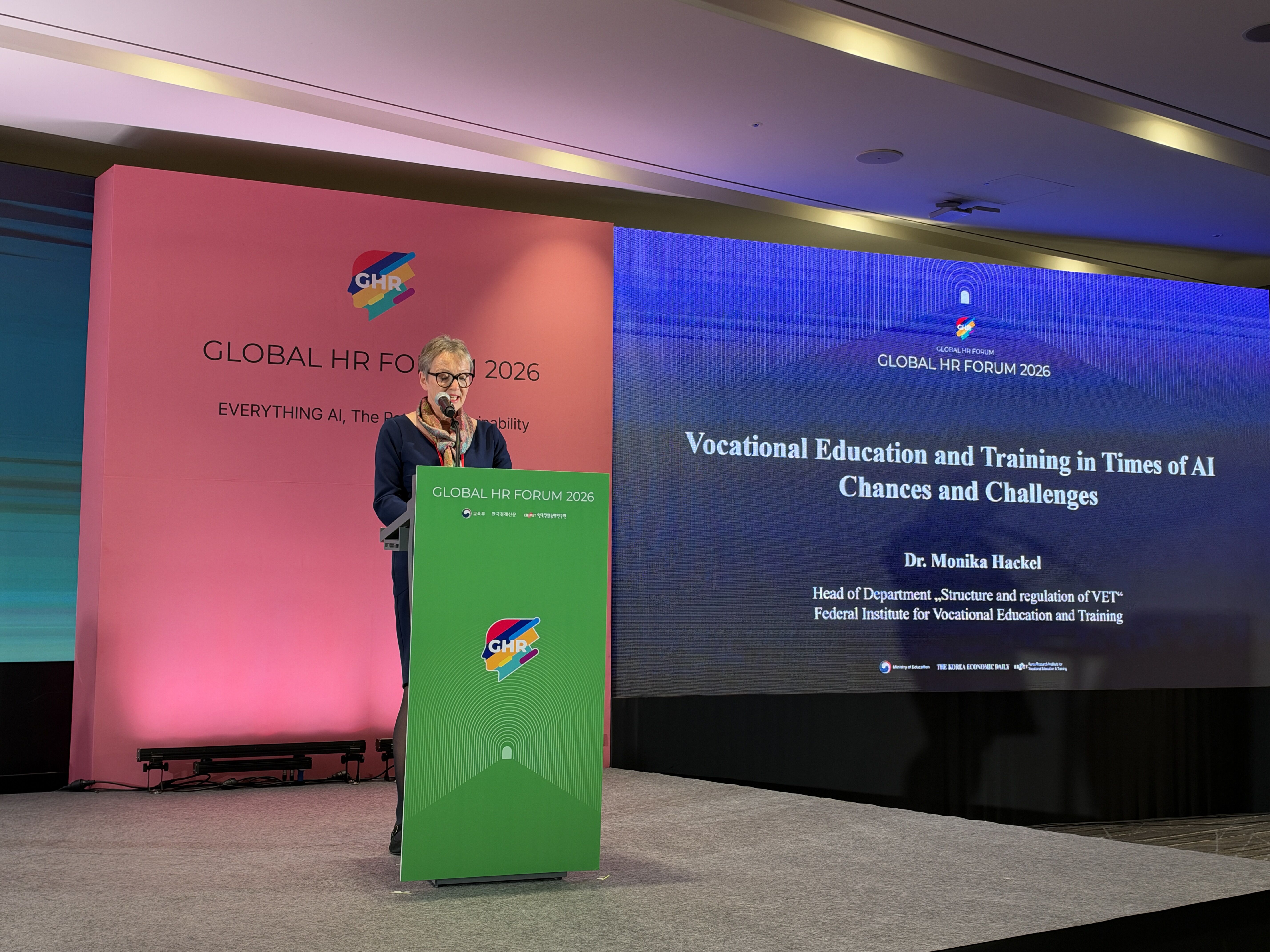
This also includes the use and integration of AI in vocational training. During a panel discussion, Dr Monika Hackel, Head of Department at the Federal Institute for Vocational Education and Training (BIBB), joined international experts to discuss the opportunities and challenges arising from the application of artificial intelligence for teaching, learning and research in vocational training. The panel was moderated by Dr Hye Won Ko, President of KRIVET.
According to Dr Hackel, the impact of AI on skills requirements is multifaceted and non-linear. She therefore advocates for vocational training research into AI that is closely aligned with the respective professions. “The potential of AI can best be realised in conjunction with the domain-specific competencies of the respective professions. It is therefore important to examine which competencies must be preserved at all costs.” She urged vocational training staff to proactively seize the opportunities for teaching and learning. In particular, she emphasised the need to take the examination system into account when considering the necessary change processes. However, it is not only initial vocational training that is being transformed by AI; those already in employment must also adapt to a changing world of work. The Institute for Adult Learning (IAL) in Singapore is exploring how to engage employees in continuing vocational education and training and facilitate access to it. In his presentation, Terence Ho, Director of the IAL, highlighted the need for lifelong continuing vocational education and training opportunities for all age groups.
Once again this year, the Global HR Forum has proved to be a venue for important social debates. “It’s fascinating to hear how certain developments are viewed in other parts of the world. One thing I’ve certainly taken away from this is that we in Germany would do well to prioritise this area and explicitly capitalise on the strengths of our vocational education and training system,” said Monika Hackel after two days of the conference programme. Looking beyond one’s own horizons is always worthwhile, particularly in times of global uncertainty. The Global HR Forum consistently provides a platform for this.