Work-based learning (WBL)
Apprenticeships are a key type of work-based learning
Find here definitions, types and criteria of Work-based Learning.
The Leaflet of the Interagency Group on Technical and Vocational Education and Training (2024) explains:
Work-based learning (WBL) refers to all forms of learning that occur in a real work environment. It equips individuals with the skills necessary to obtain, maintain and advance in their jobs and professional development.
Apprenticeships are a key type of work-based learning, designed to develop occupational skills and lead to recognised qualifications.
ETF Handbook (2018) identifies the following:
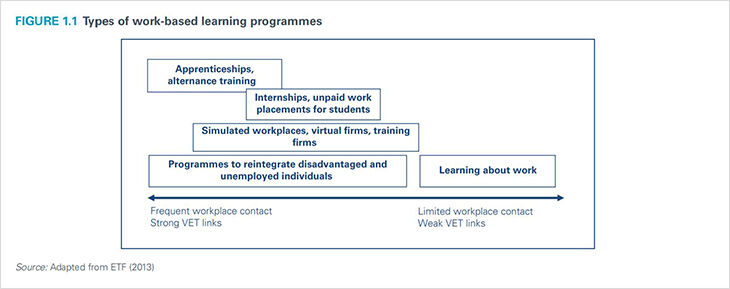
The recommendation paper ´ESF Transnational Cooperation Platform Community of Practice on Employment, Education and Skills` (2022) defines:
Work-based learning can be understood as any type of learning that happens in the workplace, in initial (VET) training, in an internship, through informal work experiences, during a career, in continuing (VET) training, and in other contexts.
Apprenticeships should be understood as a specific form of work-based learning, usually initial VET, usually leading to a qualification, that is characterised by alternance between two learning venues (VET school and company) and a high share (at least 50%) of on-the job-training. Apprentices are usually contractually bound to their training company and are often based on a tripartite agreement that is part of the social dialogue in the country.
A UNEVOC Network Contribution on Work-based Learning states a number of salient common aspects:
WBL means learning for work, learning at work and learning through work.
Learning subjects of WBL embrace not only pupils and students in formal education and training (initial VET, continuing VET or Higher Education) but also employees in companies and any other institutions involving paid work.
- WBL takes place in schools and colleges as well as in companies.
- Learning targets and outcomes of WBL are knowledge, skills, and attitudes. Their purpose is to develop professional, social and personal competence. These are important prerequisites for employability, identity formation and social integration.
- Knowledge, skills, and attitudes are developed through a reflected process of participating in work tasks in a dynamically evolving professional setting.
- Guidance from tutors and senior colleagues increases the learning potential of WBL.
- The particular strength of work-based learning lies in the acquisition of practical skills and competences.
- WBL supports the transfer and application of codified disciplinary knowledge into work situations. Furthermore, it helps to cope with demanding professional situations.
- The character of WBL can be formal (structured and intentionally planned), informal (not highly structured and planned) and incidental (happening unintentionally).
All these aspects relate to a concept of learning which is almost globally understood as a competence-based perspective on vocational education and training.
Find examples of Work-based learning under Programmes and Pathways:
- Within vocational orientation courses: pupils in primary and secondary education undertaking work-oriented projects (or visits) that involve local companies or industries.
- Within vocational pre courses: trainees undertaking a period of work-practice or work experience during the programme.
- Within internships abroad: trainees undertaking a period of work-practice or work experience as a part of their vocational education and training.
- apprentices aligning the day to day requirements of their job with related learning theory.