Dual vocational training as a response to changes in the world of work
Launch of the 2026 webinar series by the Alliance for Dual VET in Latin America and the Caribbean
25.06.2026
Changes in the world of work are placing new demands on VET systems worldwide. The Alliance’s first 2026 webinar used three country case studies to demonstrate how dual models address these challenges and what approaches institutions in Latin America have developed in response.
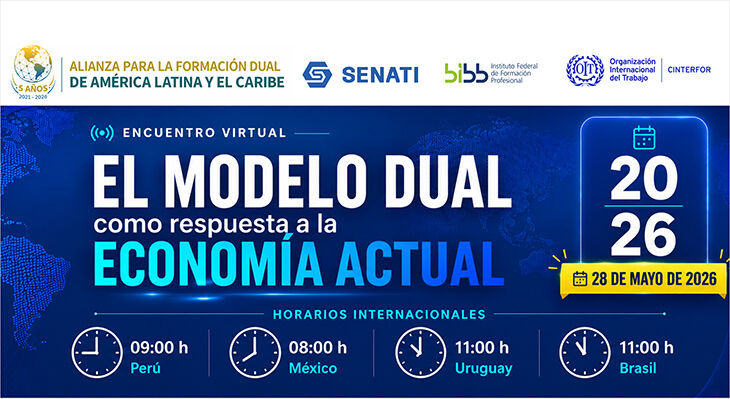
The world of work of tomorrow is shaped by technological change, artificial intelligence, demographic shifts and the need to transition to more sustainable economic models. The role that dual vocational education and training can play in this context – and how it must be strategically oriented and structured to enable viable skilled labour strategies during this transformation process – was the focus of the first event in the 2026 webinar series organised by the Alliance for Dual Vocational Education and Training in Latin America and the Caribbean on 28 May.
Over 300 representatives from VET institutions, the business sector and international organisations took part in the event, which was held under the new presidency of the Peruvian vocational education and training institute SENATI.
As a reference institution, the BIBB has supported the Alliance since its foundation and, together with the ILO/Cinterfor Technical Secretariat, facilitates the regional exchange of experiences aimed at further developing practice-oriented vocational training systems. In her welcoming address, Ilona Medrikat, project manager at BIBB, emphasised that close cooperation between companies, VET institutions and social partners is a key factor in the success of dual training, as it makes it easier to identify technological trends at an early stage, translate them into qualification strategies and facilitate young people’s transition from vocational education to employment.
Diversity of dual models in the region – shared development challenges
The webinar focused on three country case studies, which illustrated how differently dual VET is organised across the region and what common challenges exist.
Peru’s national vocational training institute, SENATI, presented its long-standing experience with a dual vocational education and training system closely aligned with the needs of industry. Key elements include competence-based curricula, the active involvement of companies in training, and structured procedures for supporting learning processes both in the workplace and at training centres.
INFOTEP, the Dominican Republic’s national institute for technical and vocational education and training, presented its model, which organises practice-oriented training and qualification programmes for companies and learners under a tripartite framework. The state, employers and employees jointly shape dual VET and view it as a tool for developing skilled workers and enhancing the competitiveness of companies. The systematic integration of learning in training centres and in the workplace forms the foundation of this approach.
UTU (General Directorate for Technical and Vocational Education and Training) from Uruguay, a central public institution for technical and vocational education and training that develops and delivers practice-oriented training programmes nationwide, demonstrated how dual elements are being gradually integrated into the public vocational education and training system. In doing so, existing training programmes are adapted to the capabilities of businesses, and cooperation between schools, companies and learners is being specifically expanded. The aim is to promote vocational competence in real-world work processes whilst simultaneously strengthening the sense of responsibility among all stakeholders involved.
Despite differing institutional contexts, it became clear from all the presentations that dual training can make an important contribution to improving the alignment between vocational education and the labour market. Practical learning processes facilitate young people’s transition into employment and help companies attract qualified skilled workers.
At the same time, challenges were identified that are common to many countries in the region. These include greater involvement of small and medium-sized enterprises, the training of in-company trainers, ensuring the quality of vocational training, and the development of resilient partnerships between educational institutions, the business sector and other stakeholders. Furthermore, issues of gender equality and inclusion were highlighted, as was the importance of evidence-based evaluation of dual vocational training programmes.
Exchange as a driver of regional development
The webinar made it clear that there is no single model for dual vocational education and training. Rather, different solutions are emerging across the countries of Latin America and the Caribbean, tailored to their respective economic and institutional contexts. The ongoing exchange within the Alliance provides an important platform for sharing experiences, learning from one another and jointly advancing the further development of dual VET in the region.
With the 2026 webinar series, the Alliance is continuing its work to strengthen dialogue between vocational training institutions, policymakers, social partners and businesses. As a reference institution, the BIBB will continue to accompany this process with its expertise and support the further development of high-quality dual vocational education and training.
The next event in the series will take place on 30 June – which also marks the fifth anniversary of the Alliance for Dual VET in Latin America and the Caribbean.