Successful launch of the “Towards a Global TVET Agenda” Initiative
09.01.2026
The Federal Institute for Vocational Education and Training (BIBB) officially launched its collaboration with four multilateral partners – UNESCO-UNEVOC, ILO, OECD and ETF – as part of BMBFSFJ’s new Initiative “Towards a Global TVET Agenda”. The Global TVET Forum in Berlin showed that impetus for a global TVET agenda is coming from all world regions!

Taking places from 28 to 30 October 2025 in Berlin, the Global TVET Forum served as a platform for a festive launch and lively exchange: Together with BIBB, the multilateral partners presented their contributions to the BMBFSJ-Initiative “Towards a Global TVET Agenda” and engaged in dialogues with approximately 110 international representatives from TVET policy, research, and practice. Over 380 online participants followed the forum via livestream.
The Global TVET Forum was organized by the UNESCO International Centre for Technical and Vocational Education and Training (UNESCO-UNEVOC), the Federal Ministry for Education, Family Affairs, Senior Citizens, Women and Youth (BMBFSFJ) and BIBB – in close cooperation with the other partners of the Initiative: the International Labour Organisation (ILO), the Organisation for Economic Co-operation and Development (OECD) and the European Training Foundation (ETF).
Recordings of the official political launch on 28 October, as well as selected sessions from 29 October, are available online on the conference website.
We have compiled the highlights for you:
The opening speeches made it clear that only through international cooperation can TVET meet the global challenges of digitalization, climate change and demographic change.
Borhene Chakroun, Director of Policy and Lifelong Learning at UNESCO, called for a clear political stance: “We need advocates at the highest political level – heads of state who are committed to promoting the importance of TVET in political agendas.” Only in this way can TVET be anchored as a strategic element in education and labour market policy.
Manuela Geleng, Director at the European Commission's Directorate-General for Employment, Social Affairs and Inclusion, also emphasized the importance of investing in people and their skills as a strategic priority. She referred to the European Vocational Training Strategy expected in summer 2026, which focuses on increased international cooperation both within and outside the EU in order to address the shortage of skilled workers and strengthen the quality and innovative power of TVET systems worldwide. “We must make skills our common currency,” Geleng continued.
 © UNESCO-UNEVOC
Catrin Hannken, Head of the Vocational Education and Training Department at the BMBFSJ, highlighted the political importance of close cooperation between the four multilateral organizations, UNESCO-UNEVOC, ILO, OECD and ETF – also for vocational education and training in Germany. She pointed out that although Germany has a proven model in its dual training system, it is also facing profound structural changes. “TVET is at the heart of our societies' future viability – but we must not allow the focus on skills overshadow the importance of recognised qualifications,” said Hannken. She emphasized that formal vocational qualifications create stability, social recognition and trust. Germany contributes its expertise in social partnership cooperation, quality assurance and VET research to the global TVET agenda.
Birgit Thomann, Head of the “International Vocational Education and Training” department at BIBB, summed it up at the launch ceremony: “Through this Initiative, we are promoting high-quality, sustainable and inclusive TVET based on the principles of dual training and work-based learning.”
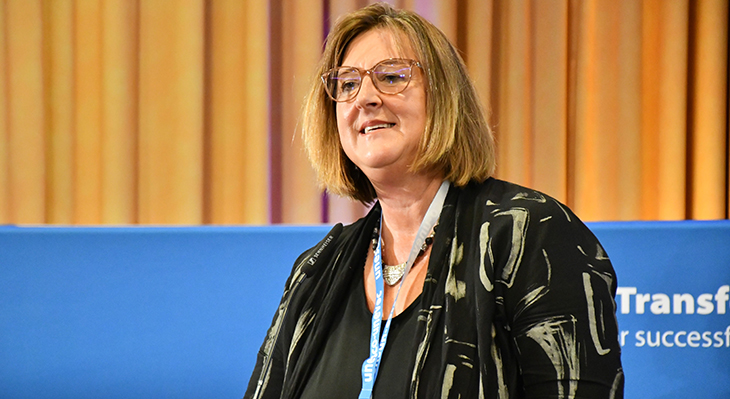
She emphasized the role of BIBB within the “Towards a Global TVET Agenda” Initiative: As a recognized centre of excellence for vocational education and training, BIBB contributes not only its technical expertise but also a strong network of international partner organizations. The launch event in Berlin was attended by cooperation partners SENAI (Brazil), KRIVET (South Korea), TESDA (Philippines) and ILO/Cinterfor, which works closely with BIBB within the framework of the “Alliance for Dual Training in Latin America and the Caribbean”.
 © UNESCO-UNEVOC
After the launch ceremony, the multilateral partners presented their contributions to the implementation of the Initiative:
- ILO: Global and regional TVET innovations – capacity building for social partner involvement
- OECD: Prototyping TVET data reporting
- ETF: Partnership for Excellence
- UNESCO-UNEVOC: Knowledge sharing and global fora
The partners' presentations made it clear that the added value of the Initiative lies in the fact that it creates the framework and opportunities for closer cooperation on common priority issues. Herein, and through exchange with the global TVET community, the essence for this global TVET agenda is formed.
WorldSkills International and WorldSkills Germany are also actively supporting the agenda process.
Laurence Gates, CEO of WorldSkills Europe, highlighted the existing cooperation within the WorldSkills Conference Coalition and emphasized that they will make targeted use of their network and platform to further advance the implementation of the global TVET agenda.
 © UNESCO-UNEVOC
At the end of the first conference day, the focus shifted to regional perspectives and youth voices. Moderated by Isabelle Le Mouillour, Head of the Division “International VET Comparison, Research and Monitoring” and Katharina Engel, Coordinator of the “Towards a Global TVET Agenda” Initiative at BIBB, representatives of the African Union Commission (AUC), ILO/Cinterfor, and TESDA from the Philippines discussed how they can support the global agenda process as regional drivers. Nicholas Ouma (AUC), Balmyrson Valdez (TESDA) and Elena Montobbio (ILO/Cinterfor) confirmed the relevance of the Initiative and its topics on behalf of their regions. They named the following as further priorities:
- Participation of industry
- Cross-border recognition of vocational training qualifications and regional qualifications frameworks
- Inclusion and gender equality
- Qualification of TVET teachers and trainers
The panel was completed by Shae White, WorldSkills Champion from Barbados. She called for young people to be given more opportunities to actively participate in processes of shaping TVET: “Their voices and perspectives must be heard”. The panel discussion clearly showed that even though geographical and demographic conditions vary, the challenges and priorities are similar across regional boundaries. Furthermore, the discussion highlighted how regional networks, shared priorities and youth participation are drivers of a globally compatible agenda.
The German UNEVOC centres also actively contributed their expertise to the forum. The Chamber of Skilled Crafts Ostwestfalen-Lippe zu Bielefeld (HWK OWL), Germany, together with Centre of Vocational Excellence Temasek Polytechnic in Singapore, led a workshop session on artificial intelligence in TVET. The session provided practical examples of how digital technologies are changing teaching and learning processes, and was moderated by Cara Schmitt, research assistant at BIBB. The Koblenz Chamber of Crafts (HWK Koblenz), Germany, participated in a panel discussion on the role of vocational training centres as drivers of excellence and innovation, emphasizing the importance of regionally based centres of excellence for international cooperation in TVET. Together with BIBB, German UNEVOC centres are important links between the global Initiative and the German vocational education and training landscape.
A particular highlight of the forum was the participation of two BIBB colleagues during the panel discussion on “Attractive and relevant vocational education and training”. Hannah Siebertz, an event manager apprentice, and Lisa Kubitschek, training coordinator, enriched the discussion with personal insights from training practice at BIBB. Particular focus was given to democracy education as an integral part of modern TVET programmes. Lisa Kubitschek emphasized: “The co-determination of trainees not only promotes their professional skills, but also strengthens their ability to make decisions independently and responsibly.” Both BIBB colleagues impressed upon the audience that TVET is more than just the transfer of technical knowledge – it creates space for responsibility, participation, and active democracy – and thus for personal development.
 © UNESCO-UNEVOC
The second day of the conference was devoted to dialogue and innovative TVET practices. In interactive workshops, conference participants worked on key topics related to the Initiative:
- Current state of TVET data and gaps
- Capacity building for social partners, policy makers and TVET networks
- Artificial intelligence
- Cooperation with the private sector
- Attractiveness of TVET
On the third day, international participants got the opportunity to see the German TVET system up-close via study visits. Among the organizations to open their doors were the Education and Technology Centre of the Berlin Chamber of Crafts, the Competence Centre of the SHK Berlin Guild, Helmut Ziegner Berufsbildung gGmbH, the BWK Bildungswerk in Kreuzberg, the Berufsförderungswerk der Fachgemeinschaft Bau Berlin und Brandenburg (Lehrbauhof Berlin) and the Berlin Senate Department for Education, Youth and Family Affairs. These excursions clearly demonstrated how labour market-relevant curricula, digital tools and inclusive learning settings work together in practice.
The Global TVET Forum 2025 showed that multilateral cooperation in the “Towards a Global TVET Agenda” Initiative lays the foundation for a credible global TVET agenda. Ultimately, the Initiative relies on strong political advocacy and partnerships, regional integration and exchange with TVET practitioners. All of which were demonstrated over the course of three days.
 © UNESCO-UNEVOC
Nils Klagge, Head of Division at the BMBFSFJ, summarised the expectations: “The world is changing at a pace that forces us to rethink vocational education and training. Let us turn projects into partnerships, ideas into implementation, and exchange into tangible progress."


