From initial engagement to long-term commitment to dual vocational education and training
18.08.2026
How do companies become long-term partners in dual vocational education and training? In a webinar organized by the Alliance for dual VET in Latin America and the Caribbean, INA Costa Rica, Globant Colombia and Nestlé Chile discussed motivation, obstacles and success factors.
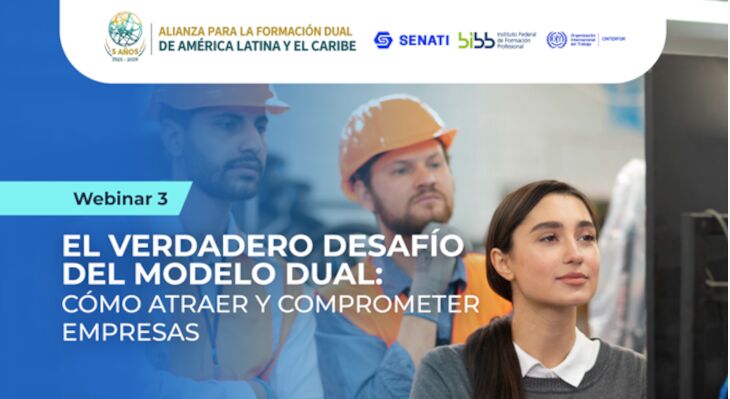
Dual vocational education and training requires companies to do more than simply provide young people with a workplace for learning: they must see themselves as long-term partners in the training process. What motivates companies in Latin America to take on this role, what support they need to do so, and what keeps them committed to the model in the long term were the focus of the third 2026 webinar organized by the Alliance for dual VET in Latin America and the Caribbean.
Under the title ‘The real challenge of the dual model: How can companies be attracted and engaged?’, representatives from vocational training institutions, politics and business held discussions on 12 August. Over 200 people from more than 20 countries took part in the event.
The event took place under the current presidency of the Alliance, held by the Peruvian VET institute SENATI. ILO/Cinterfor acts as the Alliance’s Technical Secretariat, whilst the BIBB serves as its reference institution. The webinar was opened by Walter Rioja, Head of Curriculum and Pedagogical-Technical Development at SENATI, and Ilona Medrikat, responsible project manager at the Federal Institute for Vocational Education and Training (BIBB).
Talking with, not about, businesses
Following a brief technical presentation by Erick Sandoval, an SME adviser at the Instituto Nacional de Aprendizaje (INA) in Costa Rica, the expert discussion he moderated deliberately focused on the experiences of two large, internationally active companies.
Mariana Gómez, Talent and Culture Business Partner at Globant Colombia, and Valentina Piraino, Talent Manager at Nestlé Chile, not only reported on their programmes but also discussed with one another what specifically motivates companies to get involved in dual vocational education and training, what difficulties arise in the process, and under what conditions initial participation develops into a long-term commitment.
It was precisely the comparison of two such different business contexts that made the discussion particularly illuminating. Globant is an international technology and IT services company that develops digital products, software solutions and applications relating to AI, the cloud and data for businesses. The global food and drinks group Nestlé has had a presence in Chile for over 90 years and employs more than 7,000 people there across nine factories and eight distribution centres.
Globant: From a statutory obligation to a talent strategy
Mariana Gómez reported on Globant Colombia’s ‘New Generation’ programme. The starting point for its introduction was the statutory requirement for companies to contribute to training. Globant gradually developed this obligation into a strategic tool for recruitment and talent development. The programme, which has been running for around three years, was developed in collaboration with the German-Colombian Chamber of Commerce and Industry in Medellín, the Foundation for Entrepreneurial Development Cooperation (AFOS), and the educational institutions CESDE and SENA. A distinctive feature of the programme is that participants are closely introduced to the company and supported by mentors even during the theoretical training phase. This is intended to familiarize them with the company’s requirements at an early stage and ensure they are as well prepared as possible when they begin the practical phase.
After four cohorts, the programme comprises 102 trainees or programme participants, 44 of whom have already completed their practical phase. 17 of them were subsequently taken on permanently by Globant. At the same time, more than 210 employees volunteer in various mentoring roles. This example illustrates how an international technology company builds on existing training structures and, in collaboration with partners from the education and business sectors, adapts them to the specific skills requirements of a knowledge-intensive industry.
Nestlé: Dual VET as part of a long-term youth strategy
Valentina Piraino from Nestlé Chile, meanwhile, reported on more than ten years’ experience with dual vocational education and training as part of its ‘Iniciativa por los Jóvenes’. Whilst the initiative as a whole encompasses various measures for career guidance, skills development and promoting employment among young people, dual VET falls under the ‘Entrénate’ programme. Since 2015, 1,192 young people have completed the dual vocational education and training at Nestlé Chile. The programme initially started with 22 trainees at the Maipú production site and has since been gradually expanded. In 2025, 154 young people took part. Nestlé now collaborates with 20 technical and vocational schools (liceos técnico-profesionales) across eleven different occupational fields; placements are in production facilities, distribution centres and administrative departments.
The training programme is integrated into the Chilean model of technical and vocational secondary education. The young people complete their final two years of school on a work-study basis and spend – depending on the school – two to three days a week at the company. From Valentina Piraino’s perspective, a key factor in the programme’s success is the role of the in-company ‘maestros guía’, who provide the young people with professional and personal support throughout the work process. Each year, more than 100 in-company trainers are qualified for this role in collaboration with Fundación Chile Dual.
At the same time, dual VET is linked to further pathways into employment. Graduates can, amongst other things, apply for the so-called ‘Estatuto Joven’, which enables regular employment with reduced weekly working hours, thereby making it easier to combine work with further study. Since 2019, 42 young people have taken this route; 21 of them were still employed by the company and studying at the time of the presentation, whilst seven had already completed their studies and progressed to technical roles.
Companies need demonstrable added value
Despite differences in sectors and national contexts, common factors for success emerged during the discussions. A key point is that companies should be approached on the basis of their specific challenges. This makes it possible to highlight the opportunities the dual model offers them. These include, for example, skills shortages, high staff turnover, changing skills requirements or difficulties in recruitment. From the INA’s perspective, collaboration therefore begins even before a formal contract is signed – with dialogue, the building of trust and a precise understanding of the company’s needs. The obligations and benefits of the model must be transparent; companies must be supported before, during and after the training; and results must be made visible.
The three participating countries demonstrated how varied the contexts can be under which dual training models operate. Since 2019, Costa Rica has had a legal framework for dual vocational training with defined responsibilities and governance structures; Chambers, educational institutions, the state and the business sector are linked through various dialogue formats. In Colombia, on the other hand, there is a legal obligation to employ trainees. Globant used this initially regulatory-driven involvement as a starting point to develop a tool for talent acquisition. In Chile, the dual VET system is particularly well-established in technical and vocational schools and is implemented by Nestlé in close collaboration with the schools and Fundación Chile Dual. These examples also made it clear that there is no one-size-fits-all model for corporate involvement.
Support must be tailored to the reality of the workplace
Reliable support within the workplace is crucial for long-term commitment. At Nestlé, selected and qualified ‘maestros guía’ take on this role. The role is voluntary, it is seen as an opportunity to develop leadership skills, and is supported through training, recognition and evaluation. Globant had to choose a different approach due to the highly fluctuating workload of its IT projects: There, support is shared across various roles – technical trainers, group coordinators and individual mentors. This example shows that support models must also be adapted to workplace realities. Overall, however, it became clear that dual VET is difficult to establish on a long-term basis without sufficient time, qualified support and backing from senior management.
Time, curricula and costs as key challenges
It is precisely these points that also present significant hurdles. Nestlé reported high workloads in its operations, which limit the time available to the ‘maestros guía’. Consequently, decisions are made jointly with the schools regarding how many young people can actually be properly supported – with supervision ratios ranging from 1:1 to 1:4, depending on the area of work. At Globant, the main challenges – alongside funding – include the rapid pace of change in the IT sector and, in some cases, rigid educational structures: knowledge can become outdated within a few months, whilst formal changes to the curriculum take considerably longer. Added to this are the clear demarcation of responsibilities between educational institutions and companies, as well as the question of how mentoring tasks can be distributed within the day-to-day running of the business.
Questions from the audience also focused on this interface between the education and employment systems. Among others, INFOTEP from the Dominican Republic asked how it can be ensured that curriculum content is actually implemented within the company. Globant pointed out that it coordinates the content with VET institutions even before a partnership begins and, where necessary, incorporates additional, currently relevant topics drawn from business practice. At the same time, it became clear that the formal adaptation of curricula through legal and administrative procedures often proceeds more slowly than changes in workplace skills requirements. Nestlé therefore emphasized the importance of ongoing dialogue with schools and teachers.
Sustainability requires the right framework conditions
The discussion also revealed that the sustainability of dual VET does not rest solely with companies. Participants from Chile highlighted the need for societal and professional recognition of vocational qualifications: if companies continue to prioritize university degrees, this hinders long-term career prospects for graduates of technical education programmes. In Colombia, meanwhile, it was highlighted that financial and regulatory frameworks can directly influence companies’ willingness to provide training. Calls were therefore made for faster coordination between the education and employment systems, more flexible curricula, and suitable platforms where companies, the state and educational institutions can work together on solutions.
Nevertheless, Valentina Piraino drew a positive conclusion, explaining that those who have completed the programme are now visible ambassadors for new recruits, which creates strong bonds and greater staff retention. In her experience, dual VET is not only an investment in the future, but also strengthens corporate culture and commitment. She appealed to companies:
“Don’t hesitate, have the courage to get started. You can begin with pilot projects, you can start on a small scale.”
Valentina Piraino, Nestlé Chile
From getting started to long-term commitment
In the long term, companies remain committed where they recognize concrete benefits. These included the recruitment of suitable skilled workers, lower staff turnover and induction costs, greater loyalty to the company and – as a frequently less visible effect – the development of leadership and communication skills among in-house mentors. The key finding of the discussion can therefore be summarized in a single point: simply attracting companies is not enough. They must be given the capacity to actually provide training and be able to recognize the resulting added value.
This is precisely where one of the Alliance’s key roles lies: it enables such experiences from different national systems to be brought together. As a reference institution, the BIBB supports the platform in highlighting approaches from various institutional and workplace contexts and in promoting professional dialogue on the conditions under which companies can take on long-term responsibility as places of learning and training partners.
The Alliance 2026 series of events will continue on 30 September with a fourth webinar.