Dual VET in the Digital Age: AI, Tools and Methods for Modern Skills Training in Latin America
15.07.2025
Second virtual event of the Alliance for Dual VET in Latin America and the Caribbean highlights active learning, tech-driven innovation, and competence development.
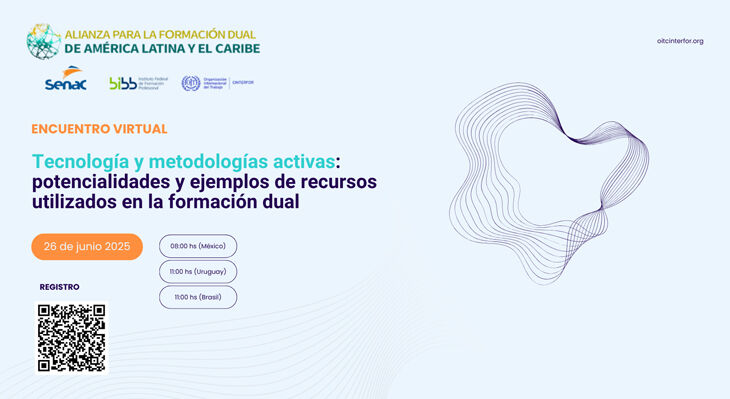
Digital tools and AI as a panacea for vocational training? Not at all. The requirements for vocational education and training staff in Latin America are growing in line with the rapid technological and social change. The second webinar of the Alliance for Dual VET in Latin America and the Caribbean in the 2025 series on 26 June 2025 provided impetus and solutions for dealing with this. The event was organised by the Alliance's coordination group, consisting of the Federal Institute for Vocational Education and Training (BIBB), the technical secretariat of ILO/Cinterfor, under the current presidency pro tempore of the VET institution Senac, Brazil: Alianza
Once again, the forum focused on digital technologies and active learning methods as key drivers for the further development of dual VET systems in the region. 134 participants from across Latin America and the Caribbean underscored the strong and growing interest in innovative, practice-oriented vocational education.
International perspectives on technology and didactic diversity
The event was opened by Anna Beatriz Waehneldt, Director of Vocational Education and Training at Senac and current Chair of the Alliance. In her welcoming remarks, she emphasized the importance of international cooperation to effectively respond to the deep technological transformations shaping society and the world of work.
The first presentation was delivered by Rodrigo Filgueira, expert at ILO/Cinterfor, who underlined the importance of promoting transversal competences such as communication, critical thinking, teamwork, and problem-solving in VET. He pointed out that many training systems in the region remain focused on tasks that are increasingly automatable. He proposed a three-phase method – challenge, collaboration, and reflection – as a catalyst for transforming teaching and learning practices.
Daniela Papelbaum, Head of Educational Technologies at Senac Brazil, presented the institution’s pedagogical model, which emphasizes active, participatory learning approaches. She introduced the CUBUS digital platform, which provides trainers in the region with innovative, tech-enhanced materials and learner-centered approaches. r: https://cubus.oitcinterfor.org/
BIBB contribution: Generative AI in VET – Opportunities and risks
The final presentation was given by Dr. Oliver Nahm, research associate at BIBB, titled: “Are you still thinking or already prompting? Opportunities and risks of generative AI in vocational education.”
Dr. Nahm explored how generative AI can support personalized learning paths, lesson planning, and new assessment formats, while also addressing key concerns such as disinformation, declining critical thinking, and emotional detachment in the learning process. His conclusion: AI can be a powerful educational tool – if applied responsibly, thoughtfully, and with clear pedagogical intent.
The new free BIBB portal Leando also contributes to this by providing knowledge and information for shaping everyday vocational education and training. On Leando, trainers and examiners can exchange ideas and network with colleagues in topic-related communities, similar to the CUBUS platform, and create individual work materials such as learning and work tasks for everyday training. Leando offers simple navigation with a central recommendation-based search function, needs-based content in the form of practical tools, information, case studies of good training and examination practices, and digital tools. In addition, the platform offers opportunities for exchange and networking with other trainers and examiners, e.g. for collegial case consultation and joint (also cross-learning location) development of materials or exchange of experience, and for individual and continuous further development of in-company training design and examination systems: https://leando.de/
Finally, Nahm referred to his ongoing research project, in which he and colleagues at the BIBB are investigating how AI can support the modernisation of vocational education and training. A new project on ‘generative AI in vocational education and training’ is currently underway and aims to assess the current state of use and develop practical support materials. The research team is currently looking for partners from all areas of vocational education and training. Vocational schools, inter-company training centres, chambers, companies and distance learning providers are invited to participate in the project. This practical approach is intended to ensure that the materials developed meet the real needs of those involved in education and training.
Interested educational institutions and organisations can contact the project team directly. Dr Oliver Nahm from BIBB is available to provide further information and discuss opportunities for participation.
Positive feedback and key takeaways
The feedback from participants across the region was overwhelmingly positive. Attendees particularly appreciated the depth, practical relevance, and clarity of the presentations. Thanks to a smoothly functioning simultaneous translation tool, the sessions were accessible in Spanish, Portuguese, and English – helping to broaden participation and understanding.
Looking ahead: The Alliance as a platform for innovation and exchange
As reference institution for the Alliance for Dual VET in Latin America and the Caribbean, the BIBB continues to actively contribute its expertise in vocational education and training to international cooperation with partners across Latin America and the Caribbean. This event reaffirmed that the combination of digital technology, activating methods, and a human-centered pedagogical approach is key to equipping young people with the skills needed in an evolving labor market – both in the region and in Germany.
The Alliance therefore offers a valuable transregional platform for exchange, innovation and the joint development of practical, future-oriented solutions.
Next event of the Alliance for Dual VET in Latin America and the Caribbean: 24 July 2025, 4 pm German time on the topic of curriculum development, models, process, design and participation of social partners.