Philippine ambassador interested in German expertise on sustainability
31.03.2026
A busy programme focusing on sustainability in TVET awaited the Philippine ambassador in Berlin at the end of March. Among other things, BIBB shared insights into key elements of the German TVET system, an inter-company training centre and a practical methods workshop.
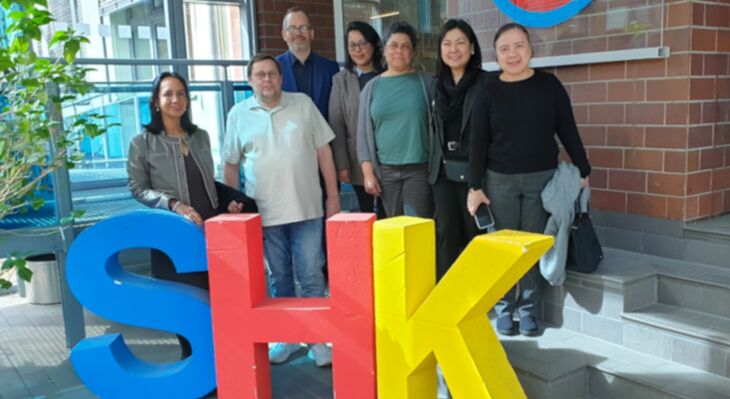
Globally speaking, the Philippines is one of the countries most severely affected by impacts of the climate change. Accordingly, the Philippine government is pursuing strategies to tackle these challenges. These also affect vocational education and training (TVET) to a particular extent, as it forms a key pillar of sustainable economic development.
To gain an overview of German strategies for sustainability in TVET, the Philippine Ambassador Maria Teresa Almojuela was in Berlin at the end of March for in-depth discussions with BIBB. She was accompanied by Mary Luck Hicarte, Minister and Economic Affairs Officer, and Jennifer Veronique Evangelista, Economic Affairs Assistant at the Philippine Embassy. In addition to learning about the key elements of the German TVET system and funding programmes, the delegation also visited an inter-company training centre and took part in a lively workshop on sustainability methods applied to real-world supply chains in TVET. The programme was organised by BIBB’s ‘International Advisory Services and Cooperation with Partner Institutions’ division, which has maintained a partnership with the Philippine Technical Education and Skills Development Authority (TESDA) since 2014.
“The green economy is existential for the resilience of the Philippines. We need to build an ecosystem from this where TVET plays a key role,” said Maria Teresa Almojuela, adding that insights from Germany were very valuable for the Philippine TVET system. Over the course of the two days, regulatory and research-related issues as well as sustainability-relevant programmes were discussed, and some of the fundamentals of the German dual system were explained. Michael Schwarz (Deputy Head of Division 3.2) provided a technical introduction and guided the lively discussion, which was followed by various valuable practical insights.
The green economy is existential for the resilience of the Philippines.
Ambassador Maria Teresa Almojuela
The Philippine Ambassador got firsthand experience of what German TVET looks like during a visit to an inter-company training centre, the Competence Centre of the Berlin Plumbing, Heating, Ventilation, and Air Conditioning Guild (SHK). During a tour, project manager Patrick Heber emphasised the societal responsibility of training the next generation of skilled workers, particularly concerning climate change: “The generation of young people now starting their apprenticeship is engaged with the issue of climate change and takes this into account when choosing their training path.”
Overall, the visit provided numerous ideas for discussing common challenges such as tailored qualifications and long-term developments in the vocational sectors, as well as potential solutions in this area.
The exchange was complemented by a discussion with Kenneth Barrientos from UNESCO-UNEVOC, UNESCO’s International Centre for Technical and Vocational Education and Training. The team leader for ‘SDGs and Greening TVET’ presented, among other things, a practical guide on sustainability, which was met with great interest.
Young people are engaged with the issue of climate change and take this into account when choosing their apprenticeship.
Patrick Heber, project manager at SHK guild Berlin
The event concluded with a short workshop organised by the German Government’s Central Office for International Vocational Education and Training Cooperation (GOVET) at BIBB. Hanno Kress presented the so called “VET Chain”, an interactive tool designed to raise awareness of sustainability among national and international TVET stakeholders. The tool illustrates TVET issues along the supply and value chain.